Evaluating AI Voice Behavior
The evaluation task focuses on determining whether AI-generated voice responses correctly follow a specified voice steer defined at the system level.
Rather than evaluating only the factual content of a response, the process examines how the response is delivered — including speaking rate, expressiveness, formality, and verbosity.
Each evaluation requires listening to competing AI responses and determining which output better satisfies the requested delivery characteristics.
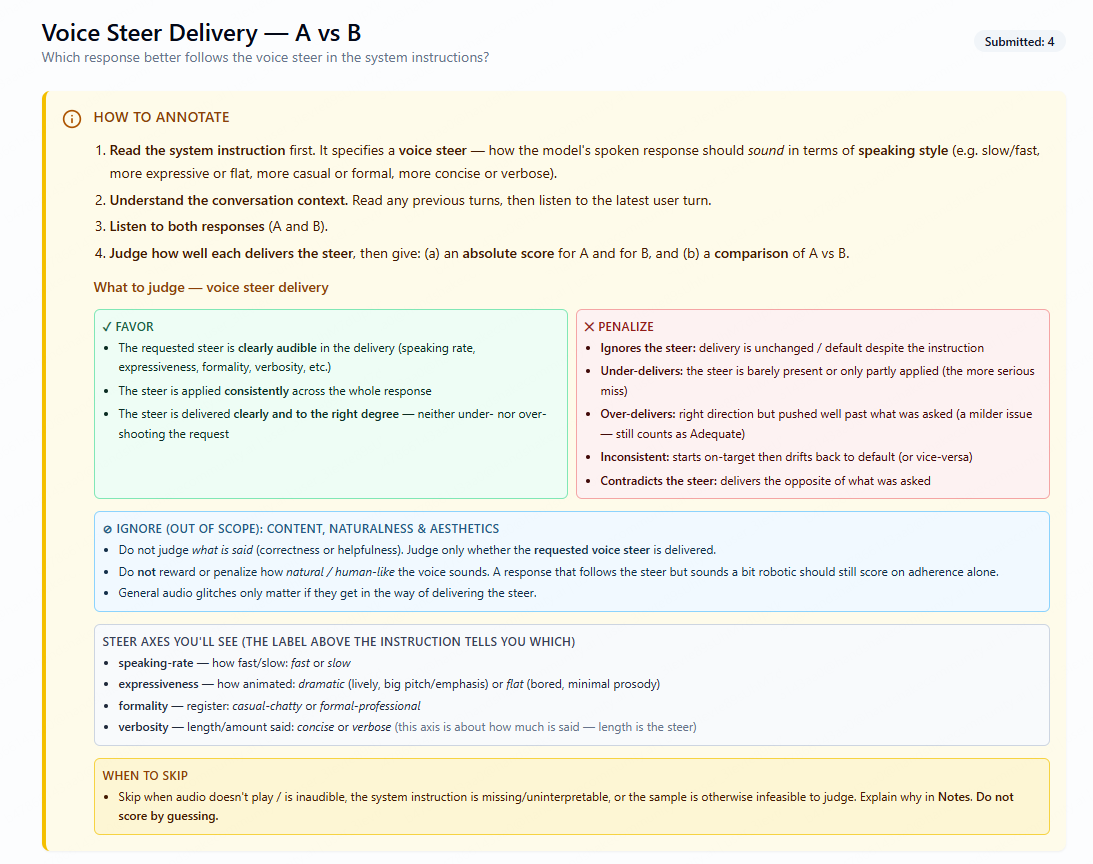
Multi-Dimensional Voice Assessment
Voice responses are evaluated across several independent dimensions. This creates a structured framework for judging whether the AI system follows the intended voice behavior.
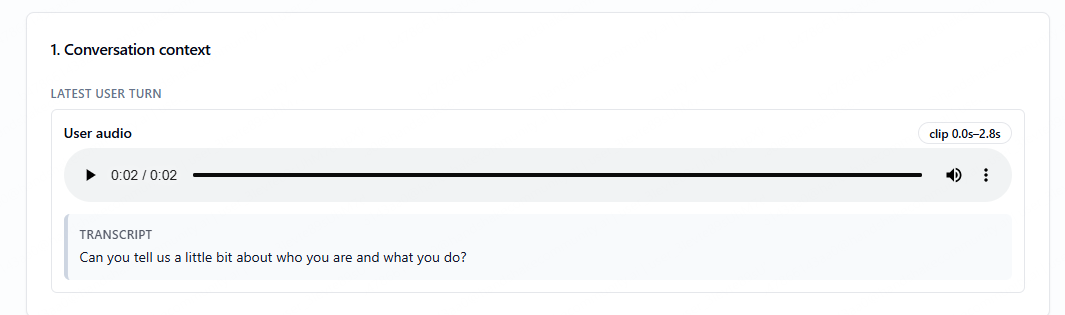
Listen → Compare → Evaluate → Report
The evaluation workflow is designed to ensure that each comparison is performed consistently. Both candidate responses are reviewed from start to finish before assigning a final judgment.
Voice Evaluation
Audio Samples
Selected audio samples demonstrating the type of AI-generated voice outputs evaluated during the assessment process.
Response A vs Response B
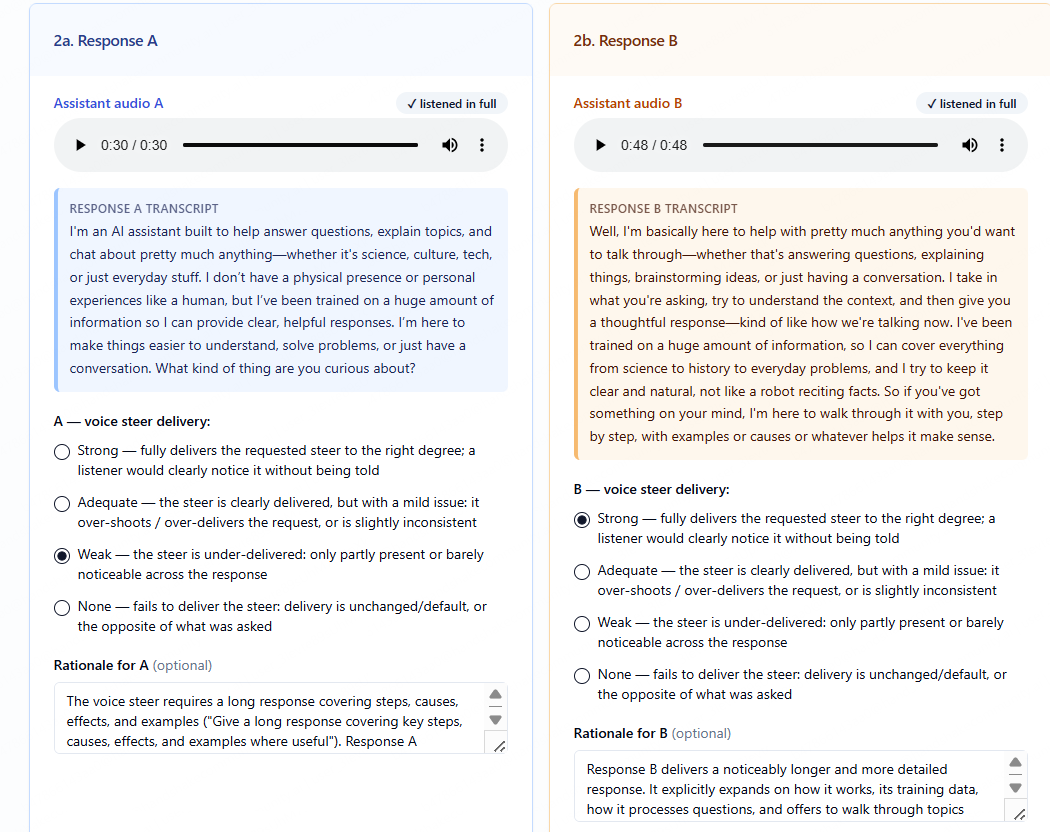
The task uses pairwise comparison to determine which AI response better delivers the requested voice steer.
The evaluator first assigns an independent score to each response and then performs a direct comparison. This separates absolute quality from relative preference .
Response A
Evaluated independently against the requested voice steer. The evaluator determines whether the response clearly demonstrates the required delivery characteristics.
Response B
Evaluated using the same criteria. The two responses are then compared to determine which one more effectively follows the system instruction.
Structured Evaluation Scale
Each response is classified using a four-level evaluation scale. The scale distinguishes strong adherence from partial or missing adherence.
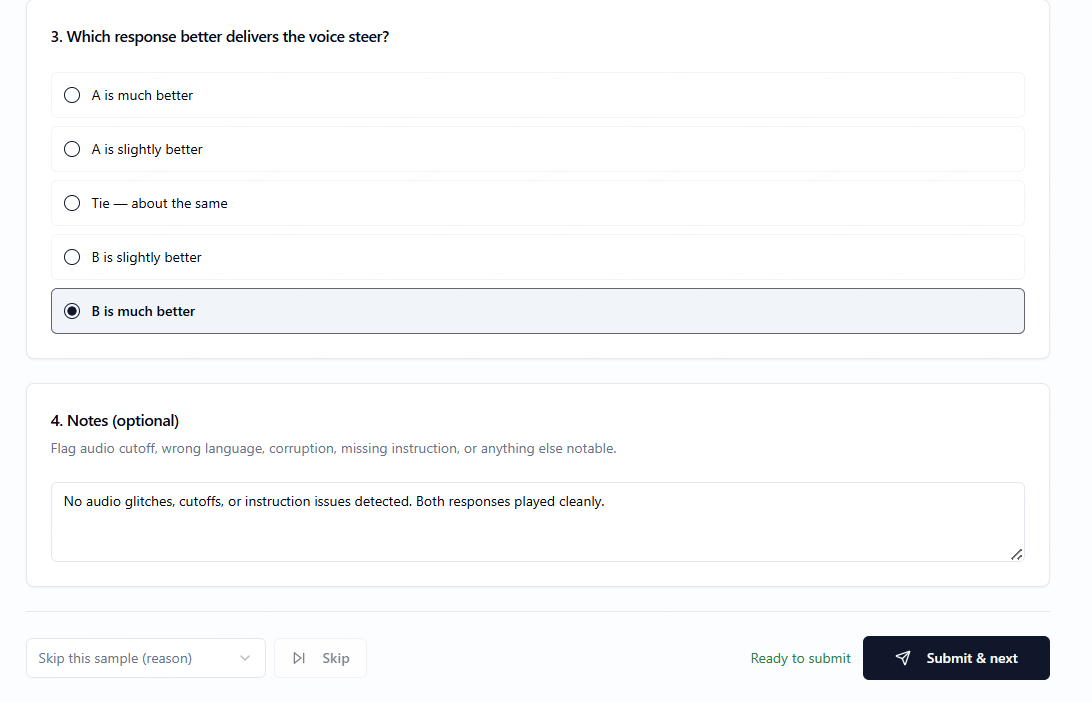
Beyond Voice Steer
Evaluation also accounts for technical or procedural issues that may prevent a response from being judged reliably.
When necessary, evaluators flag issues such as audio cutoffs, incorrect language, corruption, missing instructions, or other notable problems .
Human Judgment
in the AI Evaluation Loop
Voice evaluation provides a structured human feedback layer between AI generation and model quality assessment. Instead of treating generated responses as automatically correct, the process evaluates whether model behavior matches explicit system-level requirements.
This human-in-the-loop approach is particularly useful for qualities that are difficult to reduce to a single numerical metric, such as expressiveness, conversational register, and perceived adherence to a desired voice.
Structured AI Quality Evaluation
The work combines careful listening, structured evaluation criteria, pairwise comparison, and quality-control reporting to assess AI-generated voice behavior.
The experience demonstrates practical exposure to AI model evaluation, human-in-the-loop systems, instruction following, quality assurance, and multimodal AI output assessment .
The methodology emphasizes consistent evaluation rather than subjective preference, allowing different responses to be judged against the same explicit system requirements.

Evaluation Capabilities
The evaluation workflow builds practical experience across AI quality assurance and model behavior analysis.