Waste Image Classification
This project investigates how Convolutional Neural Networks (CNNs) can be used to automatically classify waste images into different categories.
The study compares three CNN architectures — MobileNetV2, ResNet18, and VGG16 — across three waste-image datasets with different numbers of classes and dataset sizes.
Each architecture was evaluated using both training from scratch and transfer learning to investigate how model architecture and pre-trained knowledge affect classification performance.
Comparing CNN Architectures
Three CNN architectures were evaluated under the same experimental framework. MobileNetV2 focuses on computational efficiency, ResNet18 uses residual connections to support deeper learning, while VGG16 provides a substantially larger and more parameter-heavy architecture.
The experiments show that model performance depends strongly on the dataset. On the six-class dataset, for example, ResNet18 achieved 84.21% test accuracy , while VGG16 achieved only 60.53%.
Transfer learning also produced significant improvements. MobileNetV2 increased from 89.39% to 97.04% on the 12-class dataset.
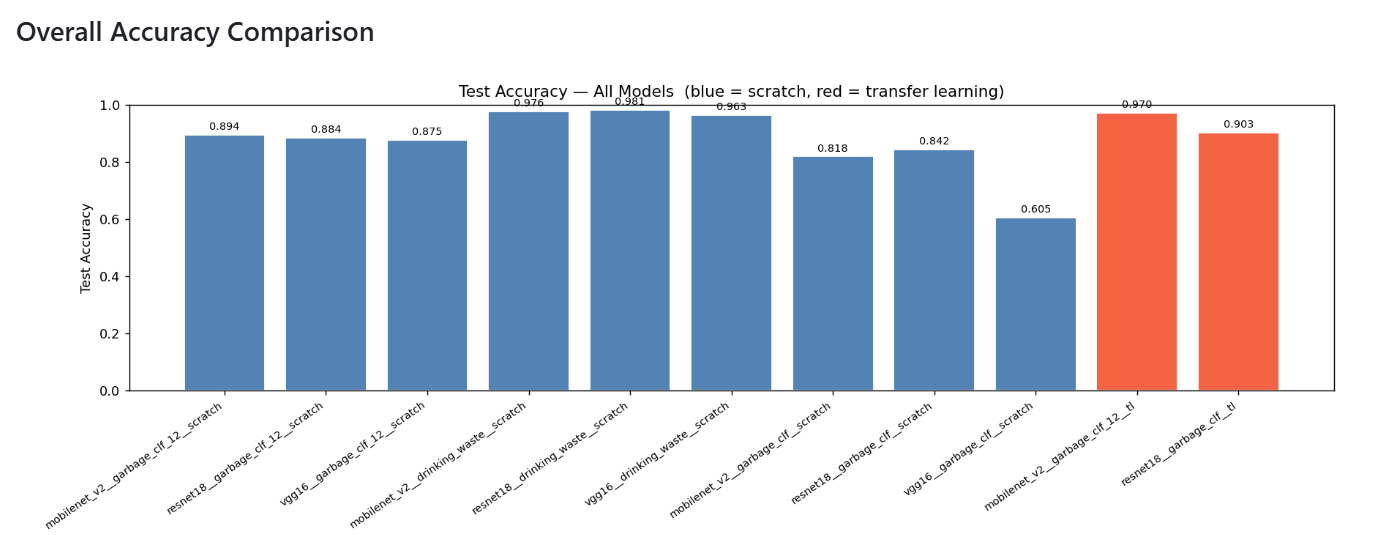
| Architecture | Drinking Waste | Garbage 6 | Garbage 12 |
|---|---|---|---|
| MobileNetV2 | 97.64% | 81.84% | 89.39% |
| ResNet18 | 98.06% | 84.21% | 88.45% |
| VGG16 | 96.25% | 60.53% | 87.50% |
Understanding Model Decisions
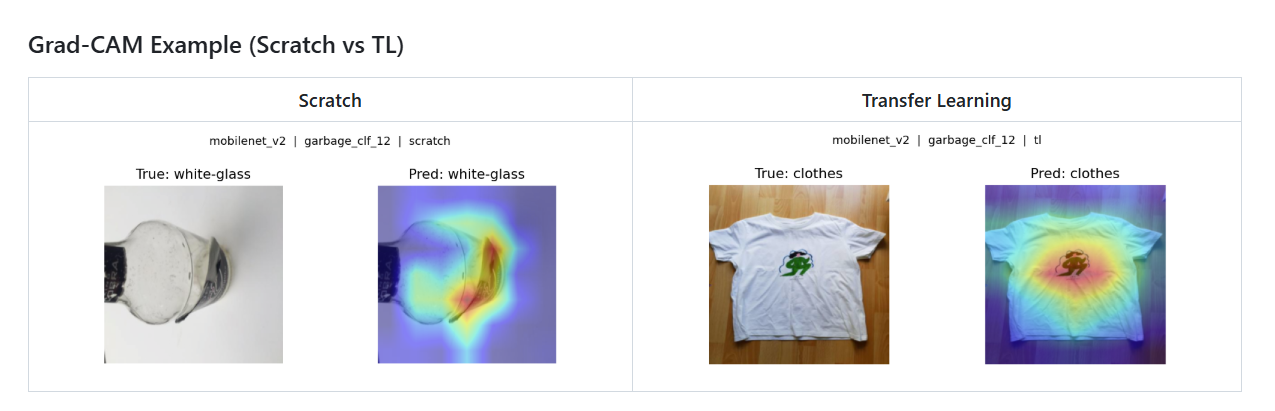
Accuracy alone does not explain how a CNN makes its predictions. To examine the model's behavior, the project uses Grad-CAM to visualize which regions of an image contribute most strongly to the model's prediction.
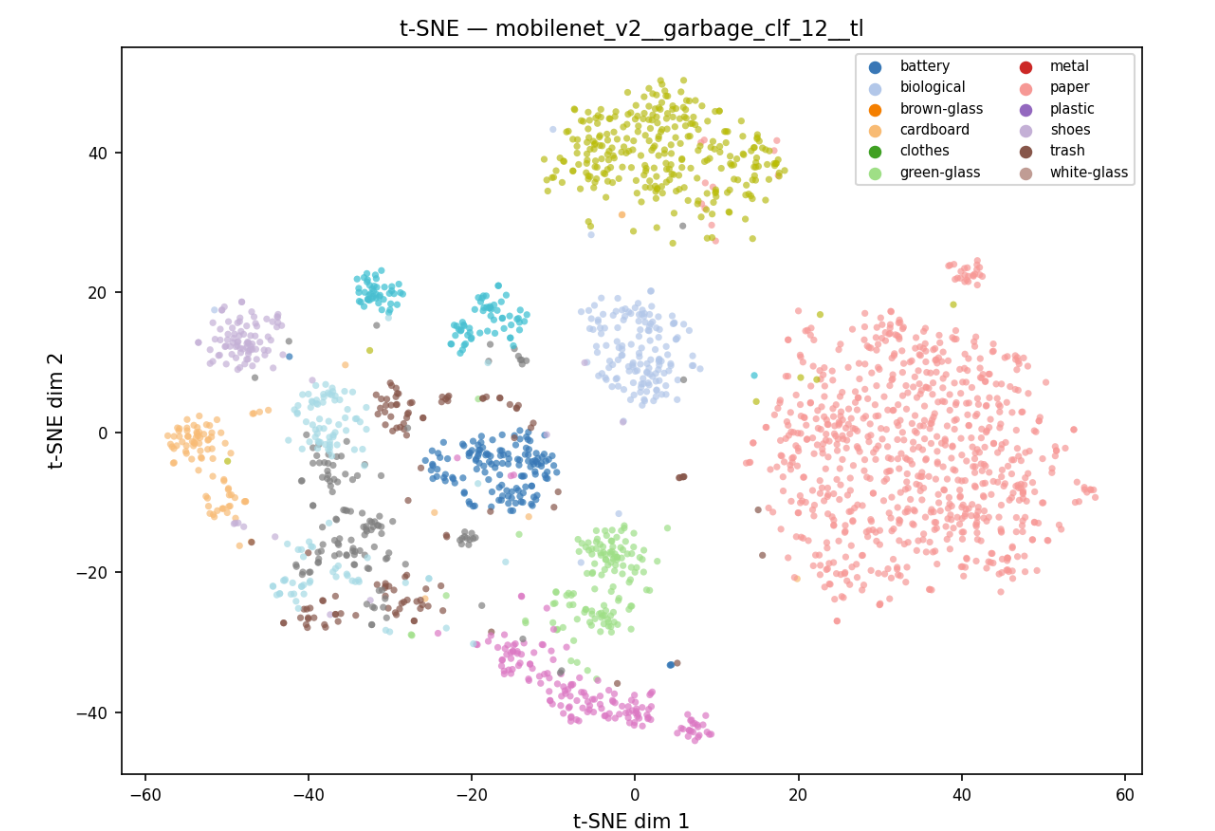
The comparison between scratch training and transfer learning provides a visual perspective on how the learned representations differ. The highlighted regions indicate the areas the model relies on when identifying the waste category.
Key Takeaway
The experiments demonstrate that both CNN architecture and transfer learning have a significant impact on waste classification performance.
Overall, transfer learning improved classification accuracy, while the comparison between architectures showed that model performance can vary substantially depending on the dataset and number of classes.
The project also demonstrates how Grad-CAM can provide additional insight into model behavior beyond accuracy alone.